Space Weather Lab
An education-first dashboard for amateur radio operators (UTC time)
At-a-Glance Indicators
HF Conditions (quick read)
Mostly stable
Heuristic based on Kp/Bz
Kp (1-minute)
0.0
as of 2026-02-04T06:01:00 · trend ↓ -0.7 / 29m
Kp (3-hour) / A (running)
Kp 0.7 · A 3.0
as of 2026-02-04 03:00:00.000
F10.7 Solar Flux
173.0
as of 2026-02-03T22:00:00
GOES X-ray
—
(— W/m²)
as of · trend —
Solar Wind (GSM)
Bz 3.7 nT · V 318.9 km/s
as of 2026-02-04 06:04:00.000 · Bz trend ↓ -2.4 / 29m
Protons (>10 MeV)
— pfu
as of · trend —
NOAA Scales
R0 / S0 / G0
Radio blackouts / Radiation / Geomagnetic
| Metric | Value | Operator impact | What to try |
|---|---|---|---|
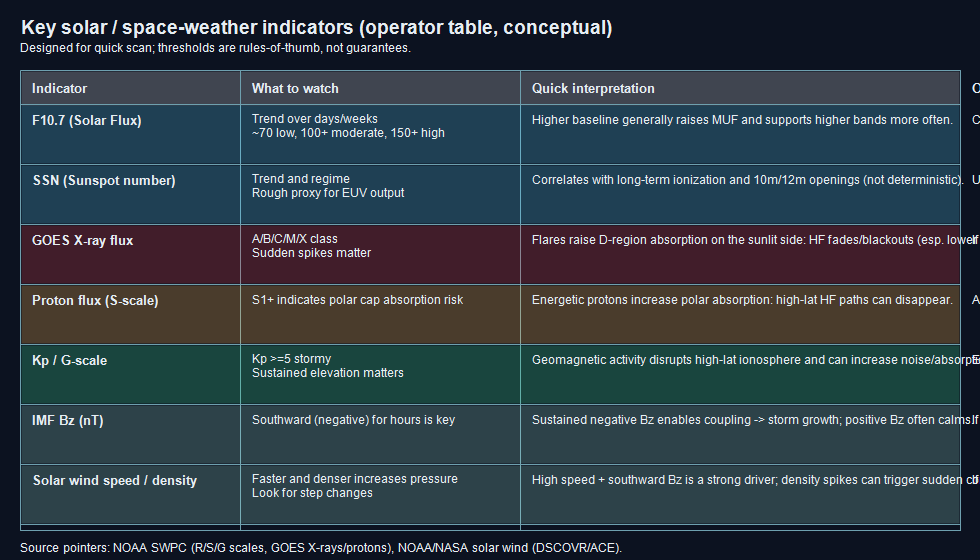
| Kp | 0.0 | Higher values often mean noisier, more unstable HF (especially polar / high latitude paths). | Favor mid-latitude routes; try lower bands after sunset; avoid polar paths during storms. |
| Kp (3-hour) / A (running) | Kp 0.7 · A 3.0 | Slower-moving “how the day is going” geomagnetic context; good for trend vs. spikes. | If Kp/A are rising: expect absorption/fading to increase; watch Bz + solar wind for escalation. |
| F10.7 | 173.0 | Baseline ionization support. Higher F10.7 generally improves higher-band odds (15m/10m). | When F10.7 is high, scan 10/12/15m in daylight; use WSPR/FT8 for quick checks. |
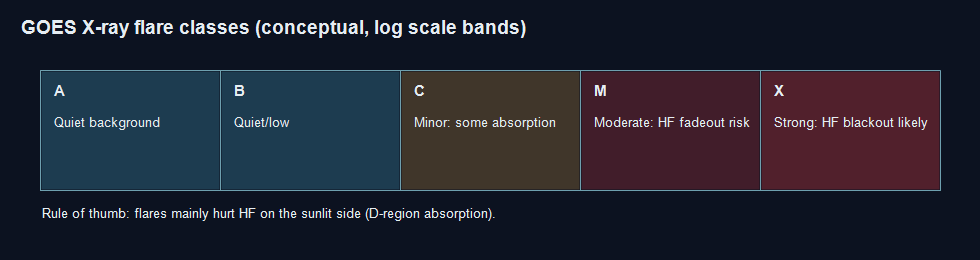
| GOES X-ray (1–8Å) | — (— W/m²) | Elevated X-ray can increase D-layer absorption (especially on sunlit paths) and cause shortwave fadeouts. | If C/M/X: try lower bands, avoid sunlit long paths; check for active alerts (R-scale events). |
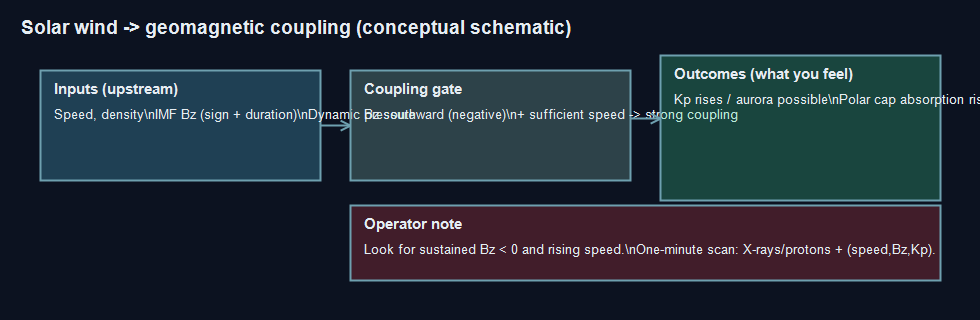
| IMF Bz (GSM) | 3.7 nT | Sustained negative Bz can “open the door” for geomagnetic activity when solar wind is elevated. | If Bz stays < 0 with high speed: expect conditions to worsen; work paths early before it ramps. |
| Solar wind speed | 318.9 km/s | Higher speed raises the ceiling for geomagnetic response (especially with southward Bz). | Watch speed + Bz together; if both are elevated, assume polar flutter and auroral absorption risk. |
| Solar wind density | 3.3 /cm³ | Density spikes can mark shocks/CMEs and increase coupling/pressure on the magnetosphere. | If density jumps: expect possible step-change; keep an eye on Kp trend and alerts. |
| Protons (>10 MeV) | — pfu | High proton flux can increase absorption at high latitudes and impacts aviation/space systems. | If S-scale rises: avoid polar circuits; consider lower-latitude paths and lower bands. |
| HF band conditions — 10–12–15 m | GOOD | High solar flux with quiet geomagnetic conditions. | Start here for most reliable contacts; expand outward to higher/lower bands by time-of-day. |
| HF band conditions — 17–20 m | GOOD | Mid bands often remain workable unless storms are strong. | Start here for most reliable contacts; expand outward to higher/lower bands by time-of-day. |
| HF band conditions — 30–40 m | GOOD | Often workable; watch storm effects on longer/high-latitude paths. | Start here for most reliable contacts; expand outward to higher/lower bands by time-of-day. |
| HF band conditions — 60–80 m | GOOD | Quiet geomagnetic conditions help stabilize nighttime HF. | Start here for most reliable contacts; expand outward to higher/lower bands by time-of-day. |
HamQSL Panels (External)
These are hot-linked images served by hamqsl.com. If you find them useful, please consider supporting them.
Embed Code (copy/paste)
This is the standard embed snippet for the selected HamQSL panel.
<center>
<a href="https://www.hamqsl.com/solar.html" title="Click to add Solar-Terrestrial Data to your website!"><img src="https://www.hamqsl.com/solar.php"></a>
</center>
Tip: If you prefer not to hotlink, use the native panels below (original artwork) and SWPC sources.
Ham Weather Panels (Native / Original)
These are original figures generated for the Space Weather Lab Guidebook, included here as “at-a-glance” panels.
Key Indicators (Quick Scan)
GOES X-ray Flare Classes
Solar Wind Coupling